The Parts of an Adapted Book
And How to Create One From Scratch
When we say “adapted book,” we don’t just mean shorter.
We mean intentionally designed so learners with intellectual and developmental disabilities can access, understand, and engage with God’s Word.
Over the years, I’ve learned that an adapted book isn’t just simplified text. It’s a collection of purposeful components working together to support understanding, communication, and participation.
Let’s walk through the key parts of an adapted book and talk about how you can create one yourself.
1. Clear, Simplified Text
Adapted text is:
Written at a lower reading level (often 1st–3rd grade)
Short sentences
Concrete language (avoid abstract phrases when possible)
Repetition of key words/phrases
Instead of:
“The Lord is my shepherd; I shall not want.”
Try:
“The Lord is like a shepherd to me.
A shepherd takes care of sheep.
God takes care of me.”
Guideline for creating your own:
Think to yourself, If I didn’t know anything about the Bible, would this wording make sense? Could I say it more clearly or more simply?
Turn to other available resources if you’re unsure how to breakdown a Biblical text. The Jesus Storybook Bible andThe Biggest Story Bible can be helpful resources. Just remember to use your own words!
2. Predictable Page Structure
Consistency reduces cognitive load. When students can anticipate what’s coming, they are more likely to be successful and engaged. Additionally, remaining consistent allows students to get used to the format of the books and work towards using them independently.
Each page might include:
1–5 short sentences
A supporting visual
Repeated sentence starters/phrases (“God made…”, “Jesus said…”, “We can…”)
Predictability helps learners:
Anticipate what’s coming
Feel successful
Participate verbally or with AAC
When the structure stays consistent, the brain can focus on meaning instead of figuring out the book’s format.
Guideline for creating your own:
Work smarter, not harder! If you want to create your own adapted books, create a template you can reuse to keep the same basic format for each book. This creates consistency for the learner as well as any volunteers who might be teaching from your materials.
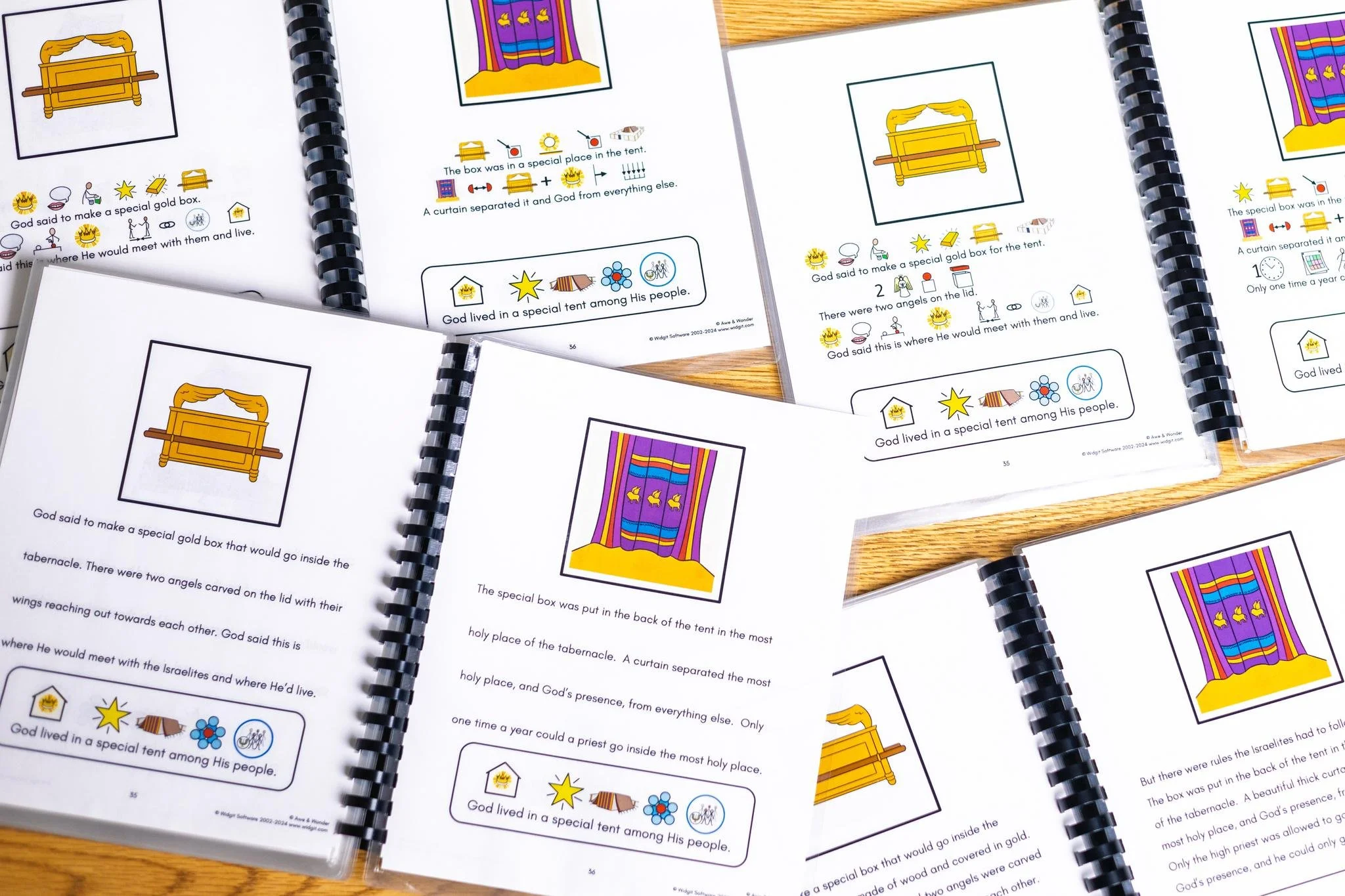
Awe & Wonder adapted books are available in 4 developmental levels. allowing for greater access within your ministry.
3. Visual Supports
In adapted books, visuals are not illustrations or decorations. They are access tools.
Effective visuals:
Match the text clearly
Are simple (not visually cluttered)
Represent key vocabulary
Support AAC users
Some adapted books include:
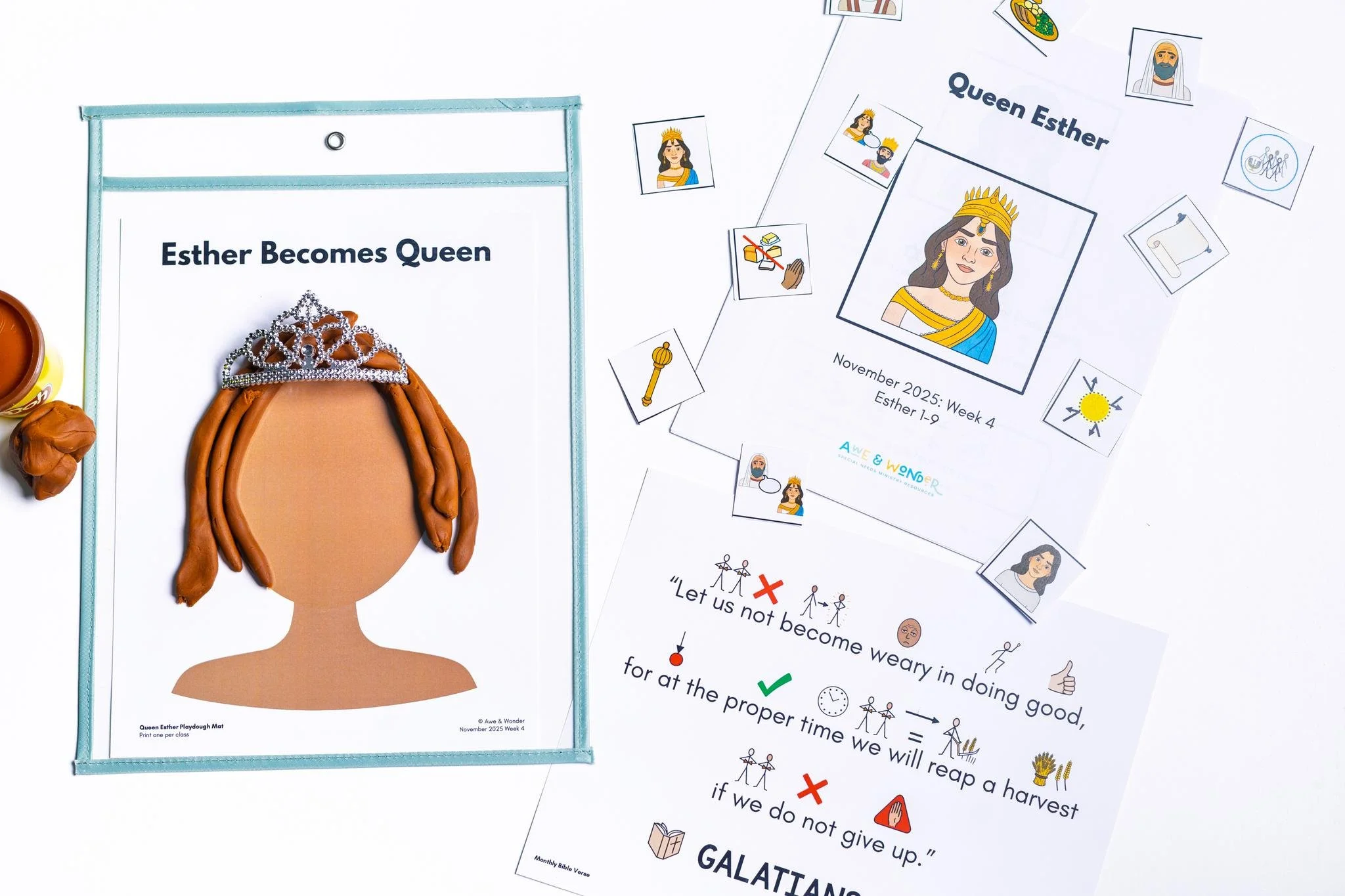
Picture symbols above key words
Visual sentence strips
Cut-and-paste interactive pieces
Matching icons
Guideline for creating your own:
Ask: If I removed the text, could the learner still understand the page from the picture paired with a simple verbal explanation?
Picture symbols can come in many forms and from many places. You can use real pictures or AAC symbols from sources such as Boardmaker, SymbolStix, and Widgit Online.
4. Repetition of Core Truths
Learners with intellectual disabilities benefit deeply from repetition, much like all of us! Repetition builds comprehension, supports memory, and reinforces theology over time.
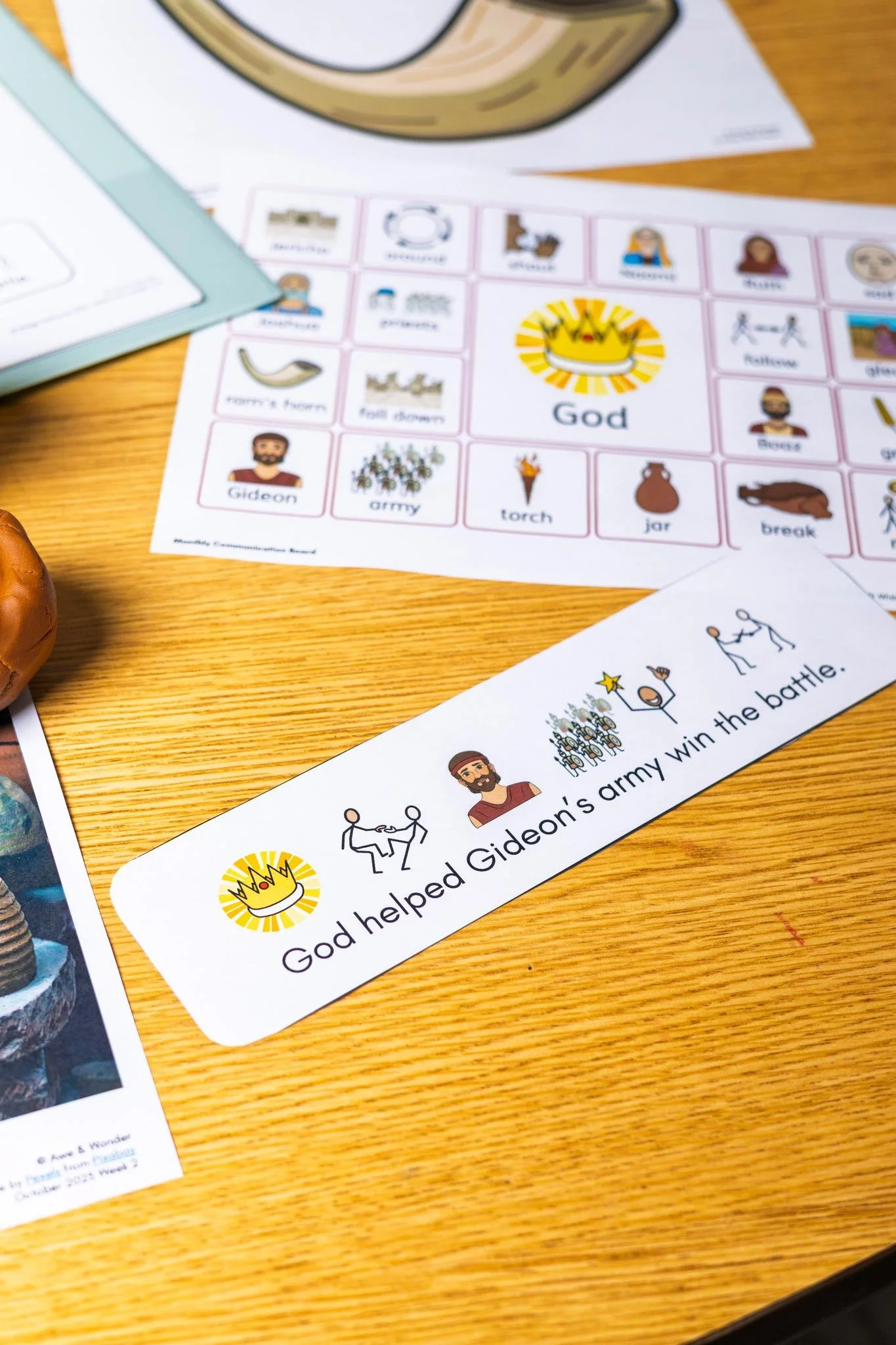
In our adapted books, you’ll often see:
A repeated theological anchor (e.g., “God keeps His promises.”)
A repeated response line students can say or sign
Familiar wording across multiple books (Gospel language repeated intentionally)
5. Embedded Definitions
Instead of assuming background knowledge, adapted books gently define terms within the story. This allows for a deeper understanding of theological truths while hearing the larger story.
Example:
“Sin is choosing our way instead of God’s way.”
Or:
“Baptism is when a believer goes under the water to show they follow Jesus.”
This prevents confusion and builds theological understanding over time.
Guideline:
If a word requires prior church knowledge, define it simply. It’s especially helpful if you are able to pair a visual with these imbedded definitions!
6. Interactive Components
Adapted books are not meant to be passive. We want learners to be excited about coming to the table to read the Bible story each Sunday!
Interaction keeps attention, supports expressive communication, and encourages participation for non-verbal learners. Even something as simple as Point to Jesus, Find the cross, or Show me “happy,” can transform a listening activity into an engaged learning moment.
They often include:
Velcro matching pieces
Yes/No response prompts
Movement cues
Sensory elements
7. Theological Faithfulness
Adapted does not mean watered down. It does mean developmentally accessible, theologically accurate, and clear about the Gospel.
In every adapted book we create, we ask:
Does this align with the Big Story of Scripture?
Does it point to Jesus?
Is it clear about sin, grace, and salvation?
Accessibility should never require theological compromise. Here at Awe & Wonder, we deeply believe that the Gospel is for everyone.